

Introduction
If your day job is in technology or is technology-adjacent, you know that you’ve automatically become the unofficial tech support for friends and family. Because my day job is working in privacy, I frequently get asked if I have hacking skills, to which the answer is no. However, after that, I sometimes get asked for advice on how people, or organisations that I’m involved in, can do better in protecting their own or their members’ privacy or the security of the organisation. This series is my response to those questions and concerns. I want to do a little research and create a useful recipe I can use as a response. That’s way better than having to extemporaneously provide an answer when having a beer at the bar after an event. That hardly ever turns out well (the response, not the bar).
When I was much more technical than I am now, I used to be a fan of the O’Reilly publishing house and their cookbooks, which were recipes for doing things with technology. That’s why I’ve called this series a digital activist’s cookbook. What I’m attempting to do here is, in each recipe, to provide an answer to a single question. For example, the first post is how to move from WhatsApp, owned by surveillance-capitalism giant Meta, to Signal, an end-to-end encrypted app that provides meaningful functionality and real privacy protection. I hope to produce a series of these recipes in the coming days, weeks, and months, and I hope you find them useful.
Who it’s for
I have been, or have engaged with, several different types of activists in my life. But the fact of the matter is, whether you’re planning a demonstration to protest surveillance capitalism, coordinating a picket line, or just arranging a meeting of your quilting club, you really shouldn’t have to worry about other people listening in or sharing information that you don’t want to share. In other words, this series is for almost everybody. Fair warning: I am writing it from the perspective of an activist who thinks there are alternatives to the way we do things today.
There are no perfect solutions.
The funny thing about privacy is that it is, in my view, social and not individual. Privacy is how two or more people protect their communications (the content of what is said) and information about their relationships (metadata about who talks to who, when, and where). So I have one expectation of privacy when I speak quietly to a friend about a confidential issue but a different expectation of privacy when I’m speaking at a public meeting in front of a large number of people. I have expectations of privacy - or, more properly, an expectation of anonymity - when I walk down the street. I want to be able to have those same expectations when I’m in the digital realm. In other words, individual privacy is dependent on context and other people.
That all being said, there is no such thing as perfect privacy. There is no such thing as complete anonymity, and there is no such thing as complete security. The more private, secure, and anonymous you want to be - especially in a world rampant with surveillance and oversharing - the more difficult it will be for you to approach your desired state. The recipes below don’t promise perfection, and I will try to explain the limits of what you can do.
Audre Lorde’s “…the master’s tools will never dismantle the master’s house” is sometimes misinterpreted to say that activists have to eschew every tool of capitalism. The fact is that sometimes you need to use the digital tools at hand. For example, you are reading my Substack right now. Substack is good for a lot of things, but it loads its reading font (Spectral) from Google’s font CDN (Content Delivery Network), so opening this post hands your IP address to Google, and I can’t change that on Substack. But like using Facebook to reach people where they are, Substack’s utility for this kind of content is appealing. And frankly, Google’s CDN is so ubiquitous that the marginal increase in risk this creates for you is, I hope, minuscule. I will say that I hope this series will help you and your friends tear down the digital master’s house.
How a recipe works
Each recipe will start with identifying what’s at stake, or what question the recipe is addressing. Once that’s established, the recipe will set out the practical steps you will need to take, and will finish with recommendations on how to check that the recipe worked. I’m still working on some of the details, so the recipe format may evolve over time. What won’t evolve is that I want to identify a problem and provide you with some practical options on addressing your concerns.
Why a raccoon
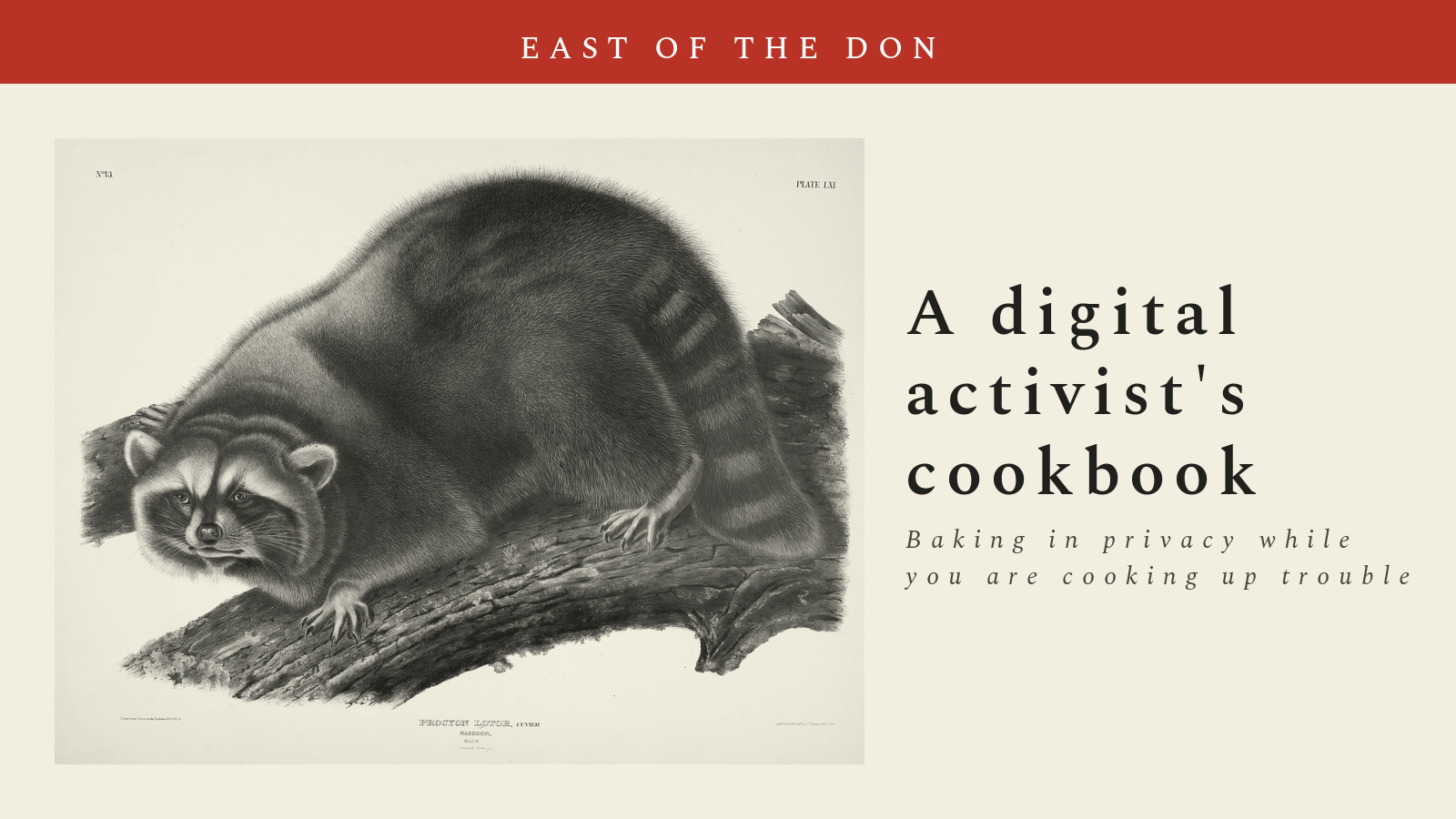
The O’Reilly books that are part of the inspiration for this series all used animals on their covers. Toronto’s trash pandas (raccoons) are all over the city and the Don River that runs through the city from the north into the lake in Toronto’s Portlands to the west of me (hence East of the Don).
The recipes
Recipes will appear here as they're published. First up: Moving to Signal from WhatsApp.
These recipes make it more difficult to watch you, but they don't make you invisible. Stopping a determined, well-resourced adversary is close to impossible. Every activist is, to some extent, a target, so weigh your own risks and decide what's worth doing. Nothing here is a guarantee, but doing something beats doing nothing.
Researched and copy-edited with AI assistance; the writing is mine.